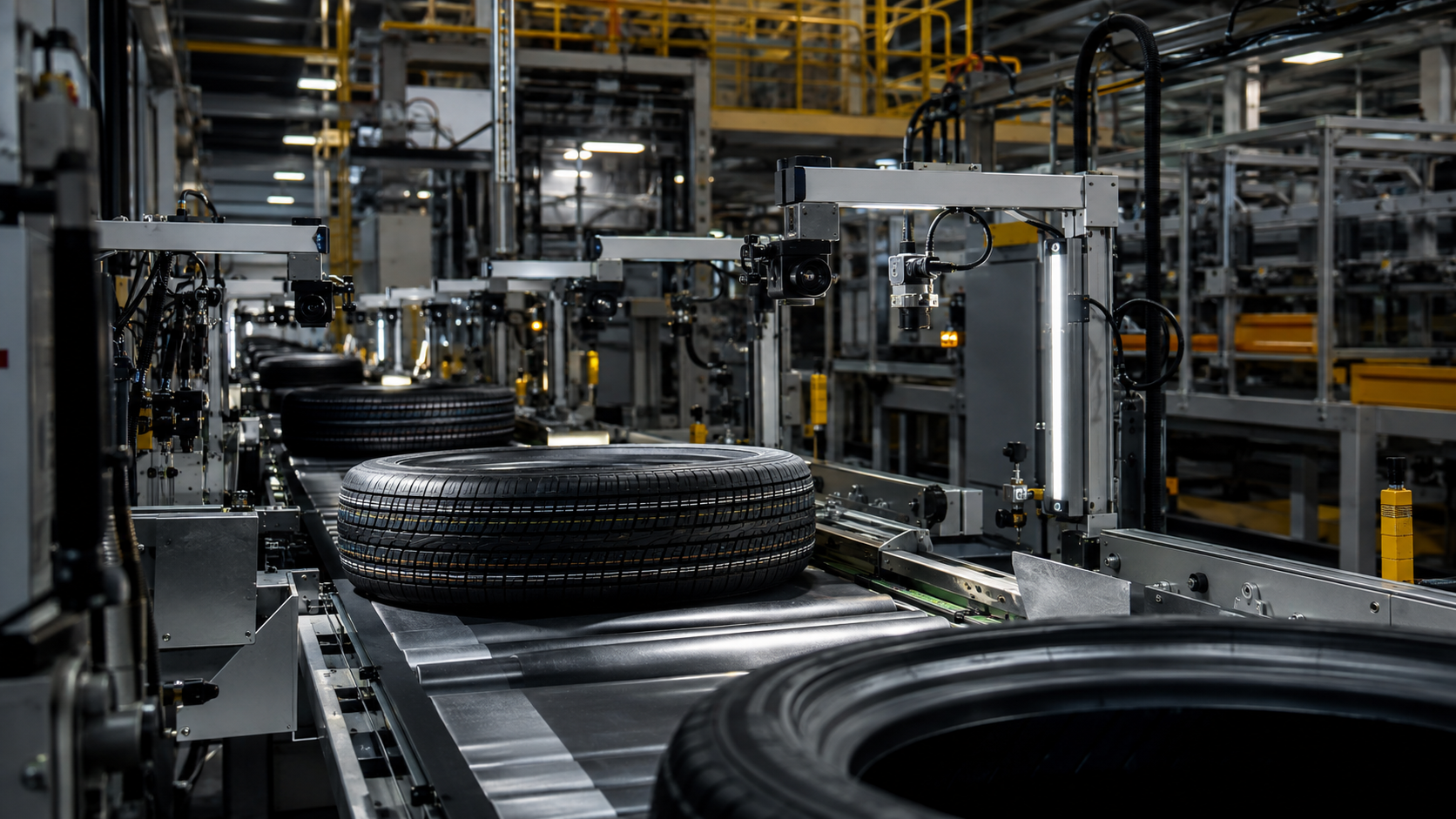
Quality Intelligence for Tyre & Rubber Manufacturing
Tyre manufacturing demands consistent dimensional accuracy, surface quality, and reliable production traceability across high-throughput production lines. Process variations in rubber compound geometry, surface defects in assemblies, and undetected splice anomalies can result in quality failures that are expensive to identify and rectify downstream. Motiontrons provides vision-based inspection, process sensing, and monitoring solutions designed to integrate across tyre production stages — from compound extrusion and cutting through building and final assembly — supporting continuous inline measurement, automated surface inspection, and structured quality records without disrupting production throughput.
What makes tyre & rubber operations complex.
Dimensional Consistency at Production Rates
Maintaining dimensional accuracy across tyre profiles at high production rates requires continuous automated measurement. Manual spot-checking is insufficient to reliably detect process drift before non-conforming product reaches downstream operations.
Surface Quality and Defect Detection
Surface defects in rubber compounds and tyre assemblies can be subtle and difficult to identify through manual inspection at production speeds. Automated surface inspection provides more consistent and comprehensive coverage across every production unit.
Production Traceability
Quality management in tyre manufacturing requires that inspection results, process parameters, and measurement data are reliably linked to each production unit — supporting root cause analysis, quality reporting, and traceability through the supply chain.
Purpose-built capabilities. Real operational outcomes.
Every Motiontrons deployment for tyre & rubber addresses specific operational challenges with purpose-built technology — not adapted general-purpose tools.
Inline Dimensional Measurement
MTX TyreInspect™ integrates into tyre production lines to perform continuous dimensional measurement of tyre profiles and rubber compound cross-sections — including bead area geometry, compound width and thickness, and profile contour parameters. Key measurements are checked against specification tolerances and non-conforming product identified before further processing.
Automated Surface Quality Inspection
Vision-based surface inspection supports automated detection of surface anomalies, compound irregularities, splice defects, and assembly variations — including material width deviations and surface damage on rubber compounds. Inspection results are recorded per production unit, supporting quality management, process control, and production traceability workflows.
Process Monitoring and Condition Sensing
Temperature, pressure, and process parameter monitoring across mixing, curing, and assembly operations provides visibility into process conditions that influence product quality. MTX SenseT™ and MTX SenseP™ capture process data continuously, enabling early identification of conditions that may indicate quality risk.
Production Traceability and Quality Intelligence
MTX Insight™ aggregates inspection and process data across the production line, linking measurement results to individual production units. Structured quality records support process improvement, root cause analysis, and supply chain traceability requirements.
From physical asset to operational intelligence.
Motiontrons connects seven integrated layers — from sensing at the asset to AI-driven intelligence at the operations level. Each layer communicates bidirectionally, creating a closed-loop system that continuously improves.
The Motiontrons ecosystem for tyre & rubber.
Relevant hardware, connectivity, and software products from the Motiontrons family — each independently deployable, deeply integrated when combined.
MTX TyreInspect™
Inline tyre profile measurement and dimensional inspection — compound cross-sections, bead geometry, and surface defect assessment across tyre production stages
MTX VisionInspect™
Vision-based inspection for surface quality, splice detection, dimensional verification, and defect detection in rubber manufacturing processes
MTX SenseT™
Temperature monitoring for mixing, curing, and process equipment in rubber manufacturing
MTX SenseP™
Pressure monitoring for curing presses, hydraulic systems, and process control
MTX Edge™
Production floor edge gateway for inspection data processing and line integration
MTX Connect™
Integration with existing production control, MES, and quality management systems
MTX Insight™
Production quality dashboard with inspection results, defect trending, and traceability records
MTX Asset™
Quality records management and production traceability
Engineering that operates under real conditions.
Motiontrons technology is designed from the ground up for industrial operating environments — not adapted from general-purpose IoT or cloud platforms.
Edge-First Architecture
AI inference and anomaly detection execute locally at the asset, maintaining operational intelligence independent of network connectivity.
Protocol-Agnostic Connectivity
Native support for OPC-UA, Modbus, PROFINET, MQTT, and a wide range of industrial protocols enables integration with existing control infrastructure without replacement.
Proprietary AI Platforms
PredictIQ™ and TwinSync™ are purpose-built industrial AI and synchronisation platforms — not wrapped consumer AI services applied to industrial data.
Industrial Hardware Standards
Sensing and connectivity hardware is designed for industrial environments with appropriate protection ratings, extended operating temperature ranges, and long service intervals.
Bidirectional Integration
The Motiontrons architecture enables both monitoring and control — not just data collection — supporting closed-loop automated responses to detected anomalies.
Deployment Flexibility
The platform supports edge-only, hybrid, and cloud deployments, adapting to site connectivity constraints and organizational data governance requirements.
Discuss your tyre & rubber application.
Speak with the Motiontrons engineering team about your specific operational challenges, existing infrastructure, and how the platform can be configured for your assets and processes.